There’s something oddly tender about numbers, even the stern ones like 5000 sitting there all stiff-backed and serious. I remember once sitting at a kitchen table with my niece, crayons rolling off the edge, and she asked me, “How much is twenty percent of my piggy bank money?” It wasn’t about the math, not really.
It was about fairness, about sharing, about figuring out what slice of something belongs where. And that’s exactly what we’re doing when we ask, What is 20 percent of 5000? We’re not just pushing digits around, we’re exploring a part-whole relationship, which is honestly more poetic than people give it credit for.
In this guide, I’ll walk you through not just the answer which, spoiler, is 1000 but the why, the how, and the small beautiful logic that makes it all click.
We’ll wander through basic math concepts, try a few percentage calculation methods, and maybe even fall a tiny bit in love with elementary arithmetic again. Or atleast feel less annoyed by it.
| Step | Operation | Calculation | Result |
|---|---|---|---|
| 1 | Convert percent to decimal | 20 ÷ 100 | 0.2 |
| 2 | Multiply by whole number | 0.2 × 5000 | 1000 |
Understanding the Heart of Percent: What Does 20% Really Mean?
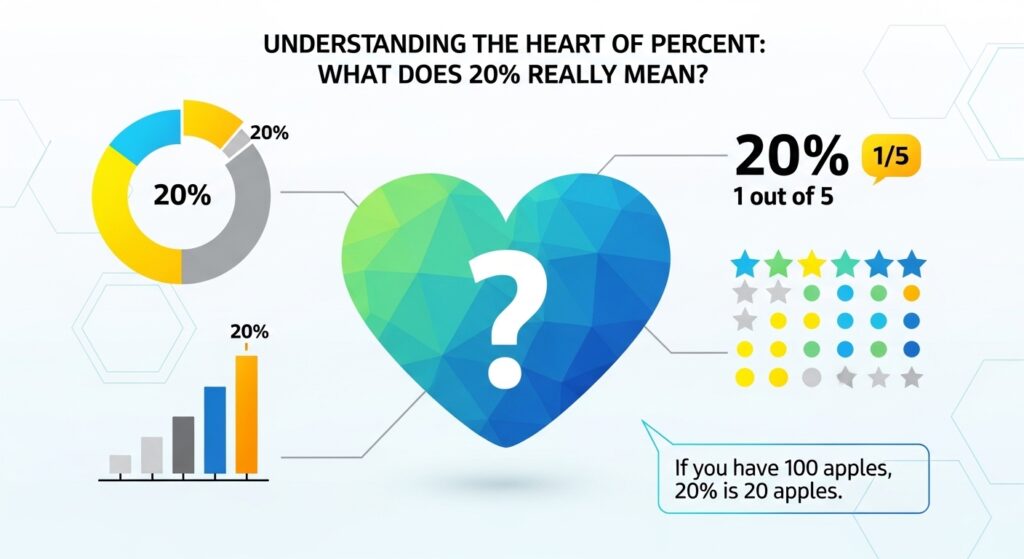
Before we even touch 5000, we need to talk about Percent (Percentage). The word percent literally means “per hundred.” That’s it. That’s the big secret. It’s just something out of 100.
So when we say 20%, we are saying 20 out of 100. In math language, that becomes a Fraction: 20/100. Here, 20 is the Numerator, and 100 is the Denominator. If you squint at it long enough, you’ll see it’s just a neat little Ratio wearing formal clothes.
This is the beginning of Finding a percentage of a number, and it’s always about identifying the Whole and the Part. In our case:
- The Whole is 5000
- The Percent is 20%
- The Part is what we’re trying to find
And there’s a formula, one that feels almost comforting in its reliability:
Percent formula:
Part = Percent × Whole
See? It’s not scary. It’s just Multiplication dressed up with a label.
Method One: Converting Percent to Decimal (The Quickest Route)
If someone asks me how to find 20% of 5000, I usually whisper back, “Let’s do a percent to decimal conversion.” Because this method is clean, simple, and kinda elegant.
Step 1: Convert percent to decimal
To do this, we Divide percent by 100. That’s it.
20 ÷ 100 = 0.2
So now we’ve completed the step called Convert percent to decimal. We’ve turned 20% into 0.2. And decimals, despite their tiny dots, are very powerful.
Step 2: Multiply decimal by whole number
Now we take that 0.2 and multiply it by the Whole, which is 5000.
0.2 × 5000 = 1000
That’s the answer.
20% of 5000 = 1000
This method is part of what many teachers call decimal multiplication, and it’s one of the fastest percentage calculation methods around. When someone Googles “how to calculate 20 percent” or “20% of 5000”, this is often the method they’re really looking for, even if they don’t know it yet.
It’s almost funny how something that looks complicated melts into something so small.
Method Two: Converting Percent to Fraction (For the Classic Thinkers)
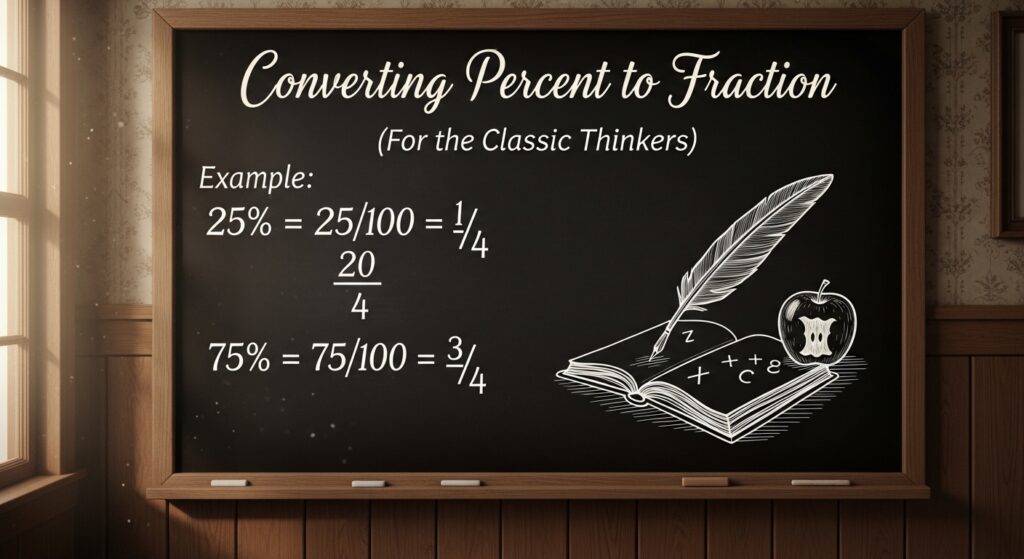
Some people prefer the percent to fraction conversion approach. And honestly? I respect that. There’s something grounding about fractions. They feel old-school, like chalkboards and careful handwriting.
Step 1: Write percent as a fraction (20/100)
So we Write percent as a fraction (20/100).
20/100
This is where Converting percent to fraction begins.
Step 2: Simplification
We reduce the fraction. Both 20 and 100 can be divided by 20.
20 ÷ 20 = 1
100 ÷ 20 = 5
So 20/100 becomes 1/5.
That’s called Simplification, and it makes everything neater. Cleaner. Less cluttered.
Step 3: Multiply result by given number
Now we multiply the simplified fraction by the Whole:
1/5 × 5000
Which becomes:
5000 ÷ 5 = 1000
There’s a gentle satisfaction in this method. It feels balanced, like a perfectly folded letter. This approach reinforces the part-whole relationship, reminding us that 20% is just one-fifth of something.
So again, the answer is 1000.
Method Three: The Proportion Method (For the Algebra Lovers)
If you’re into Writing proportions and solving tiny mysteries with Equations, this one’s for you.
We set up a Proportion:
20 / 100 = x / 5000
Here, x is the Unknown variable the thing we’re solving for. This is classic Solving equations territory.
Step 1: Set up a proportion
20/100 = x/5000
Step 2: Cross-multiply
Now we do Cross-multiplication (also called Cross-product, depending on who’s teaching you).
20 × 5000 = 100 × x
Which becomes:
100,000 = 100x
Step 3: Simplify equation
Now we use Division to isolate x.
100,000 ÷ 100 = x
x = 1000
This method is often called the proportion method, and it’s common in algebraic equation solving. It’s especially helpful in more complex percentage word problems, where the numbers aren’t as neat.
And again because math likes consistency the answer is 1000.
Why the Answer is 1000 (A Little Mathematical Reasoning)
Let’s pause and think intuitively. Twenty percent is one-fifth. If you divide 5000 into five equal chunks, each chunk would be:
5000 ÷ 5 = 1000
So even without heavy formulas, your brain can sense it. This is the beauty of mathematical reasoning. It’s not just about rules. It’s about patterns.
Whenever someone asks, “What is 20 percent of 5000?” they’re asking for a percent of a number, which always follows this structure:
Part = Percent × Whole
Or rearranged:
Percent = (Part / Whole) × 100
These are examples of a percent equation, and they’re fundamental to solving percent problems.
Once you see it, you can’t unsee it.
Common Mistakes When Solving Percent Problems
Even simple math percentage examples can trip people up. I’ve seen it happen, and I’ve done it myself when I wasn’t paying attention.
Some common slip-ups:
- Forgetting to convert 20% into 0.2 before multiplying
- Dividing 5000 by 20 instead of multiplying
- Mixing up the Numerator and Denominator
- Skipping Simplification when using fractions
- Misidentifying the Whole in a word problem
One key trick in keyword-based operation identification (“of” = multiply) is remembering that when a problem says “percent of a number,” the word “of” almost always means Multiplication. It’s a small word doing a big job.
That little linguistic clue saves so many headaches, honestly.
Real-Life Applications of 20% of 5000

Now let’s bring this down from theory into life. Because numbers don’t just live in textbooks.
If you earn 5000 dollars a month and you save 20%, you’re saving 1000 dollars. That’s powerful.
If a store offers a 20% commission on 5000 in sales, someone earns 1000.
If you donate 20% of a 5000 fundraising goal, you contribute 1000.
This is why understanding how to find percentage matters. It’s not just an academic thing. It’s budgeting, business, discounts, taxes, generosity, growth. It’s adulting, basically.
And when someone searches for a “percentage calculator example” or wants to “solve percentage manually,” they’re usually trying to make a real decision.
Step-by-Step Problem Solving Recap
Let’s gently review this as a full math step-by-step solution:
- Identify the Whole: 5000
- Identify the Percent: 20%
- Convert percent to decimal: 20 ÷ 100 = 0.2
- Multiply decimal by whole number: 0.2 × 5000
- Final Answer: 1000
Or:
- Write percent as a fraction (20/100)
- Simplify to 1/5
- Multiply by 5000
- Get 1000
Or:
- Set up a proportion
- Cross-multiply
- Solve the Equation
- Get 1000
Different roads. Same destination.
Read this Blog: https://trendsoras.com/how-is-long-7-inches/
Why Learning to Calculate Percentage Still Matters
In a world full of apps and instant calculators, you might wonder why we even bother with this stuff. Why not just type it in and move on?
Because understanding Mathematical operations builds confidence. It strengthens logical thinking. It trains your brain to see structure instead of chaos. And that skill bleeds into everything negotiations, investments, planning, even creative problem solving.
When you understand Equivalent fractions, Converting percent to decimal, and the rhythm of Division and Multiplication, you’re not just solving a problem. You’re building a mental toolkit.
And that toolkit sticks with you longer than you think.
How to Get Better at Percentage Word Problems
If you want to sharpen your skills in word problem solving, here are some practical tips:
- Always identify the Whole first
- Translate words into math operations
- Look for “of” (means multiply)
- Write down the percent formula before solving
- Double-check your decimal placement
- Estimate mentally to see if your answer makes sense
- Practice different percentage calculation methods
Over time, these become second nature. You stop panicking when you see a percent sign. You start recognizing it as just another symbol in the story.
And math, weirdly enough, becomes less intimidating.
Final Answer: What is 20 Percent of 5000?
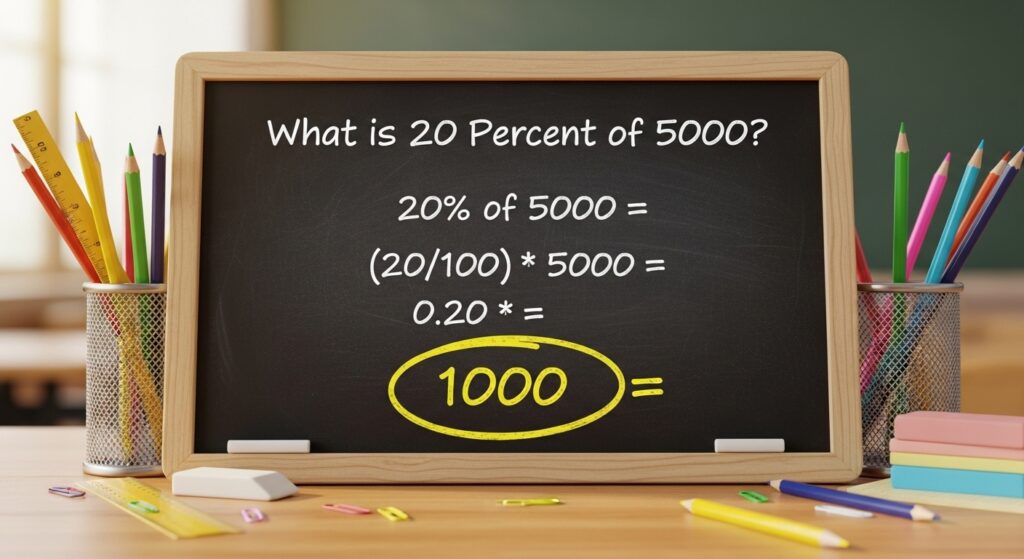
Let’s say it clearly.
20% of 5000 is 1000.
Not 100.
Not 500.
Not 1500.
It’s 1000.
Because:
Part = Percent × Whole
1000 = 0.2 × 5000
That’s the clean, simple truth of it.
Frequently Asked Questions
20% of 5000
20% of 5000 equals 1000. You calculate it by multiplying 5000 by 0.20.
what is 20% of 5,000
20% of 5,000 is 1000. Convert 20% to 0.2 and multiply it by 5,000.
20 of 5000
20 of 5000 means 20 percent of 5000, which equals 1000. It represents one-fifth of 5000.
5000/20
5000 divided by 20 equals 250. This is simple division, not a percentage calculation.
what is 20% of 5000
20% of 5000 is 1000. Use the formula: Percentage × Whole = Answer (0.2 × 5000 = 1000).
A Warm Little Conclusion
There’s something satisfying about solving something completely. Starting with a question like “What is 20 percent of 5000” and walking all the way through it, step by careful step, until it settles into clarity.
We used Converting percent to decimal, Converting percent to fraction, Writing proportions, and even a bit of algebraic equation solving.
We explored Ratio, Proportion, Fraction, Decimal, and the ever-dependable Equation. We leaned on Simplification, Cross-product, and a touch of intuition.
And in the end, we didn’t just calculate percentage. We understood it.
If this breakdown helped you, try explaining it to someone else a friend, a sibling, a kid staring at homework like it insulted them. Teaching locks knowledge into place in a way nothing else does.
And if you’ve got another percent problem you’re wrestling with, share it. Math isn’t meant to be a lonely sport. It’s a conversation, sometimes messy, sometimes surprisingly beautiful.