

Sometimes, numbers feel like little stories waiting to be told. I remember sitting at my grandma’s old wooden table, the one with little ink scratches and stains from years of paper folding, trying to make sense of fractions.
She would smile at me, her eyes twinkling, and say, “Numbers are like people, darling. Some stand alone, some mingle, some split into parts… but all tell a tale.”
And today, we’re going to tell the tale of 114/12 improper fraction, and how it magically transforms into a mixed number / mixed fraction fraction with a whole number and proper fraction.
Don’t worry if this feels a bit “mathy” at first; we’ll make it human, we’ll make it cozy, and maybe even a bit whimsical.
Fractions aren’t just abstract scribbles on a page they’re little windows into real life. Whether you’re slicing a cake, splitting a chocolate bar, or figuring out how many hours of sleep you get when the baby wakes up at 3 am…
fractions are everywhere. And understanding the numerator top part of a fraction and denominator bottom part of a fraction isn’t just for school. It’s a skill, a tiny superpower for everyday life.
| Step | Operation | Result |
|---|---|---|
| 1 | Divide numerator by denominator | 114 ÷ 12 = 9 remainder 6 |
| 2 | Write whole number quotient | 9 |
| 3 | Place remainder over denominator | 6/12 |
| 4 | Simplify fraction using GCF | 6/12 → 1/2 |
| 5 | Final mixed number | 9 1/2 |
Understanding 114/12: The Improper Fraction
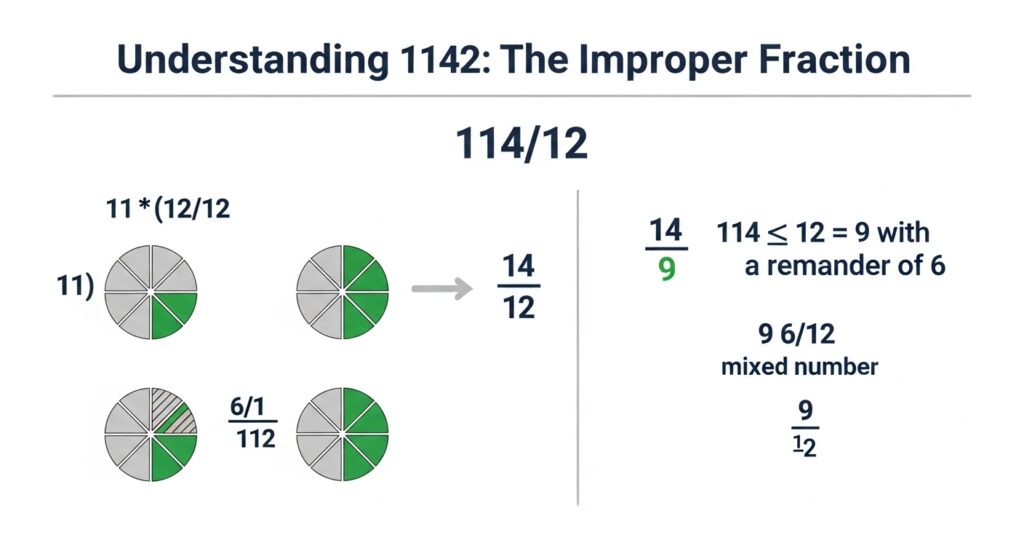
So first things first, 114/12 – improper fraction. An improper fraction is one where the numerator is bigger than the denominator. Sounds simple, right? But let’s unpack it with a little story.
Imagine you’ve baked 114 mini cupcakes and you want to place them into dozen-sized boxes each box holds 12 cupcakes. How many full boxes can you make, and how many cupcakes are left hanging around feeling lonely?
This is exactly what happens when we divide arithmetic operation 114 by 12. The numerator ÷ denominator division is our starting point.
- Step 1: Divide the numerator (114) by the denominator (12).
- Step 2: Identify the whole number quotient result of division ignoring remainder.
- Step 3: Note the remainder leftover from division.
In our cupcake example, 12 goes into 114 9 times fully (that’s our whole number quotient), and 6 cupcakes remain (that’s our remainder).
So right away, we see the connection: improper fractions are just fractions waiting to tell a story in parts whole numbers and leftovers.
Step-by-Step Conversion to a Mixed Number
Let’s make this practical, because nothing beats a step-by-step process procedural instructions when it comes to fractions. This is where the magic happens.
Step 1: Identify the numerator and denominator.
In 114/12, 114 is the numerator, 12 is the denominator.
Step 2: Divide numerator by denominator.
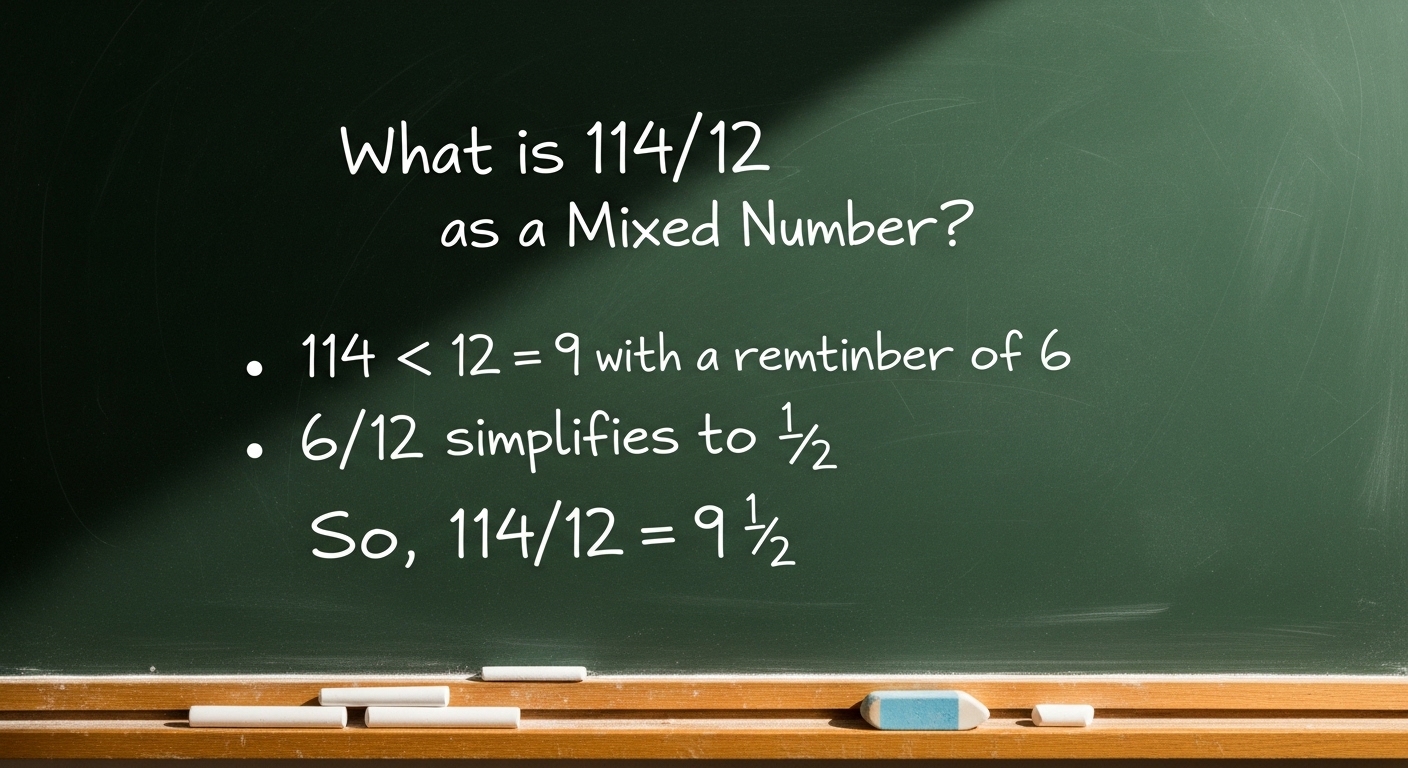
114 ÷ 12 = 9 with a remainder of 6.
Step 3: Write the whole number quotient.
This is the “full boxes” part of our story. So, the 9 goes on the outside.
Step 4: Place the remainder over the original denominator.
The 6 leftover cupcakes become 6/12, which is our fraction part remainder fraction part.
Step 5: Simplify the fraction part using the Greatest Common Factor (GCF) / Highest Common Factor (HCF).
The GCF of 6 and 12 is 6, so 6/12 simplifies to 1/2.
Voilà! The mixed fraction equivalent is 9 1/2 whole number + fraction.
Why Convert Improper Fractions to Mixed Numbers?

Now, you might wonder why bother with all this? Why not leave 114/12 as it is? Well, mixed numbers are easier to understand intuitively. It’s like telling a story in a way that everyone can picture:
- 114/12 is just a math symbol.
- 9 1/2 is nine full boxes and a half box. You can literally see it.
This is why educators, chefs, and even parents who split bedtime snacks love mixed fraction – fraction with a whole number and proper fraction. It’s tangible, relatable, human.
Real-Life Analogies: Fractions Everywhere
I once met a carpenter who swore by fractions more than rulers. He told me, “If you can’t see the 9 1/2 inches on a board, you’ll cut it wrong and ruin the whole table.” And he was right. Fractions are real life disguised as numbers.
Think about these examples:
- Sharing 114 candies among 12 kids. Each kid gets 9 candies, 6 left over. That leftover? The fraction.
- Driving 114 miles in 12 hours. You cover 9 miles an hour, with a bit extr 1/2 mile, to be precise.
- Watering 114 plants with 12 liters. Each plant gets 9 liters, half a liter remains.
Suddenly, 114/12 isn’t abstract anymore; it’s alive, it’s practical, it’s something you can see and touch.
Different Ways to Express 114/12 as a Mixed Number
Fractions are playful. There isn’t just one way to express them. You can play with equivalent fraction – fraction representing the same value in simpler form to show off a bit of flair.
- 9 1/2 our classic, simplified form.
- 18/2 + 1/2 = 19/2 treating it as a sum of simpler parts.
- 36/4 + 1/2 = 36 1/2 /4 just to confuse your friends (math humor alert!).
The point is, conversion – changing from one fraction type to another allows flexibility and shows deeper understanding.
Common Mistakes When Converting Improper Fractions
Even experienced folks trip over these tiny details:
- Forgetting to simplify the fraction using GCF/HCF. You might end up with 9 6/12 instead of 9 1/2. Looks messy.
- Mixing up numerator and denominator. Remember: numerator = top, denominator = bottom. Simple but crucial.
- Ignoring the remainder fraction part. People sometimes stop at the whole number quotient.
A quick tip: always ask yourself, “Do I see the leftover portion clearly?” If yes, you’re on the right track.
read this Blog: https://trendsoras.com/how-many-cups-are-in-12-fluid-ounces/
Fun Facts About Fractions and Mixed Numbers
- The word “fraction” comes from the Latin fractio, meaning “to break.” Imagine each fraction as a little broken piece waiting to be whole again.
- Mixed numbers date back to ancient Egyptians. They loved seeing numbers as sums of wholes and parts, much like we do today.
- Converting improper fraction mixed fraction isn’t just math it’s a mini storytelling exercise. You’re describing parts and wholes, leftovers and completion.
Stepwise Method for Fraction Conversion: Making It Stick
For anyone who struggles to remember, here’s a cheat code. Think in steps / step-by-step process:
Step 1: Numerator ÷ Denominator Whole number quotient.
Step 2: Find remainder Fraction part.
Step 3: Simplify fraction using GCF Mixed number.
Step 4: Double-check by converting back to improper fraction. 9 1/2 × 12 = 114. Bingo!
It’s almost meditative, like peeling layers off an onion, discovering the hidden value underneath.
Practical Tips for Teaching or Sharing Mixed Numbers
Whether you’re a parent, tutor, or self-learner, making fractions relatable works wonders. Some ideas:
- Use everyday objects: candies, pens, spoons. Let kids divide arithmetic operation physically.
- Turn it into a story. “You baked 114 cookies… how many boxes?”
- Compare improper fraction vs mixed number visually. Half of learning is seeing.
Even my little cousin got it instantly once we compared cupcakes in boxes vs just saying 114/12. She exclaimed, “Ohhh, so some cupcakes get lonely!”
114/12 as a Mixed Number: Step-by-Step Recap
Let’s summarize our journey with a mathematical tutorial / learning content vibe:
- Start with 114/12 improper fraction.
- Divide 114 ÷ 12 = 9 remainder 6 Whole number + remainder.
- Write remainder over denominator: 6/12.
- Simplify fraction using GCF 1/2.
- Final mixed number = 9 1/2 whole number + fraction.
Notice how each tiny step connects to real-life scenarios? That’s why fractions feel less scary once you humanize them.
Frequently Asked Questions
What is 114/12 as a mixed number?
Answer: 114/12 as a mixed number is 9 1/2.
How do you convert an improper fraction to a mixed number?
Answer: Divide the numerator by the denominator, write the quotient as the whole number, and the remainder over the denominator as the fraction.
What is the numerator and denominator in 114/12?
Answer: The numerator is 114 (top part), and the denominator is 12 (bottom part).
How do you simplify the fraction part in a mixed number?
Answer: Find the GCF/HCF of the numerator and denominator of the fraction part and divide both by it.
Why is 114/12 easier to understand as a mixed number?
Answer: It shows the whole number + leftover fraction, making it more visual and relatable in real-life situations.
Conclusion: More Than Just Numbers
Fractions are more than lines and dots. They tell stories of sharing, dividing, balancing, and sometimes, leftover surprises.
Converting 114/12 improper fraction to 9 1/2 mixed number / mixed fraction fraction with a whole number and proper fraction isn’t just an academic exercise it’s about seeing wholes, parts, and connections in everything around us.
So next time you slice a cake, split candies, or wonder how many hours of sleep you really got, remember: the numerator top part of a fraction and denominator bottom part of a fraction are your guides, the whole number quotient result of division ignoring remainder is your story anchor, and the remainder leftover from division is the tiny magic that completes the tale.
Fractions, mixed numbers, simplification they’re everywhere, alive in our kitchens, schools, gardens, and hearts. And now, whenever you see 114/12, you won’t just see numbers; you’ll see 9 1/2 little pieces of story, waiting to be shared.